introduction to flow models
https://www.pi.website/blog/pi07 https://diffusion.csail.mit.edu/2026/index.html
Time dependent vector fields
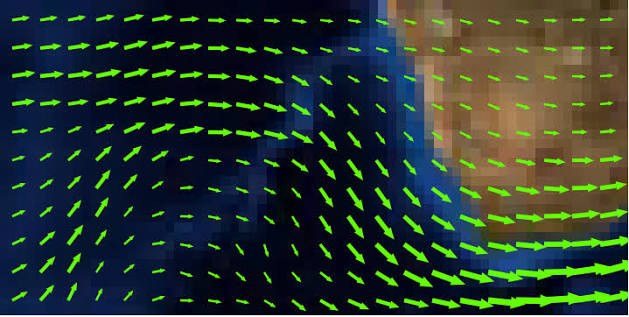
- A time dependent vector field maps a point ‘x’ in space and time ‘t’ to a velocity vector
- mathematically we define such field as u(x,t) or just as ut(x)
- ex- wind direction (the velocity of wind at every point in space and time would be different)
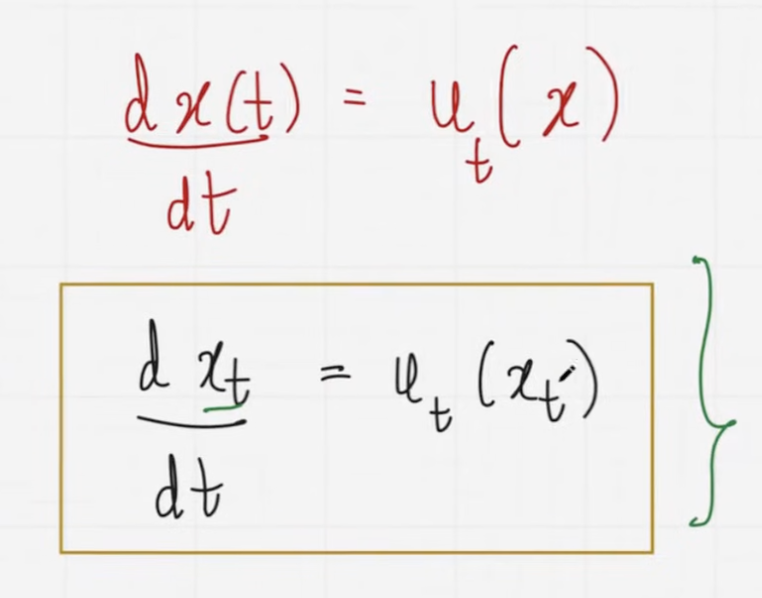
- interestingly the velocity field is responsible to change the trajectories of points as:
- the central question which we want to address is:
- if a point starts at x0 at t=0 and follows the vector field, where does the particle reach at a later time?
- to answer this question we need to solve the above differential equation
- the idea is to use the velocity vector to advance the point in small time increments
defining flow
- collection of trajectories which evolve according to the vector field
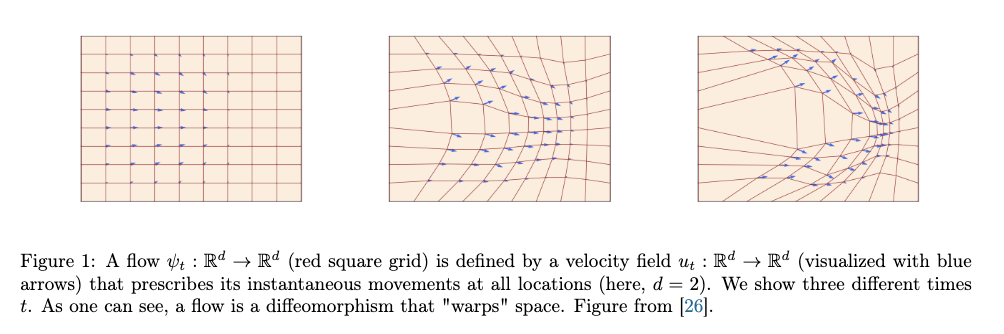
so in sequence we have Velocity Field → Trajectories → Flow
Let’s take an example:
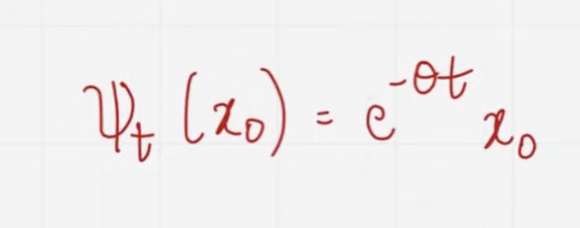
- suppose we have a velocity vector field given by :- ut(x) = -𝛉x
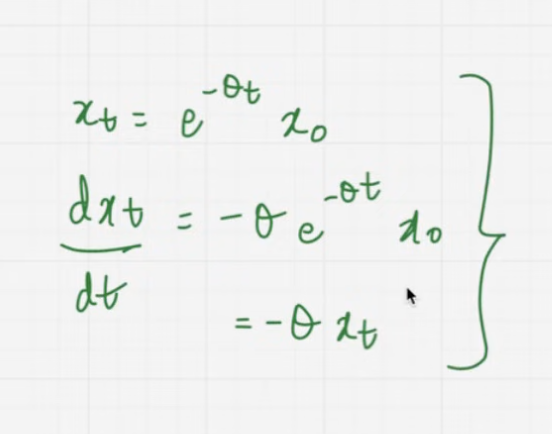
- then the flow field is given as follows (how can we check if this is valid?)
differential equation:
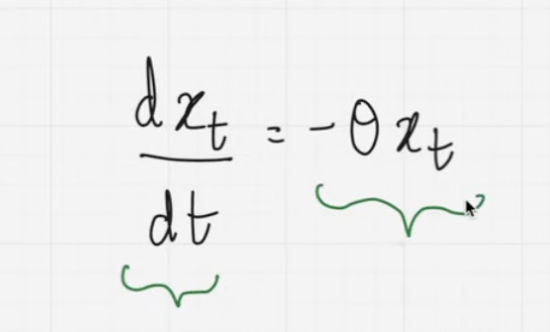
if the flow field is replaced in the differential equation and it satisfies the equation it is a valid flow field:
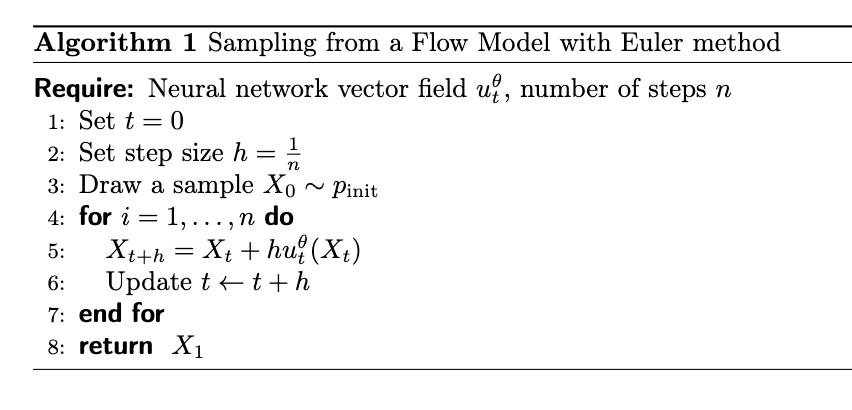
Once we have an ODE, how do we simulate it an find the trajectories?
- We use Euler method in inference to simulate the trajectories and find the final state!
- We simply take small steps in the direction of vector field
Flow models:
- goal is to convert a simple dist pinit to a complex dist pdata
- simulation of an ODE is a natural choice for this transformation
- a flow model is described by the following ODE:
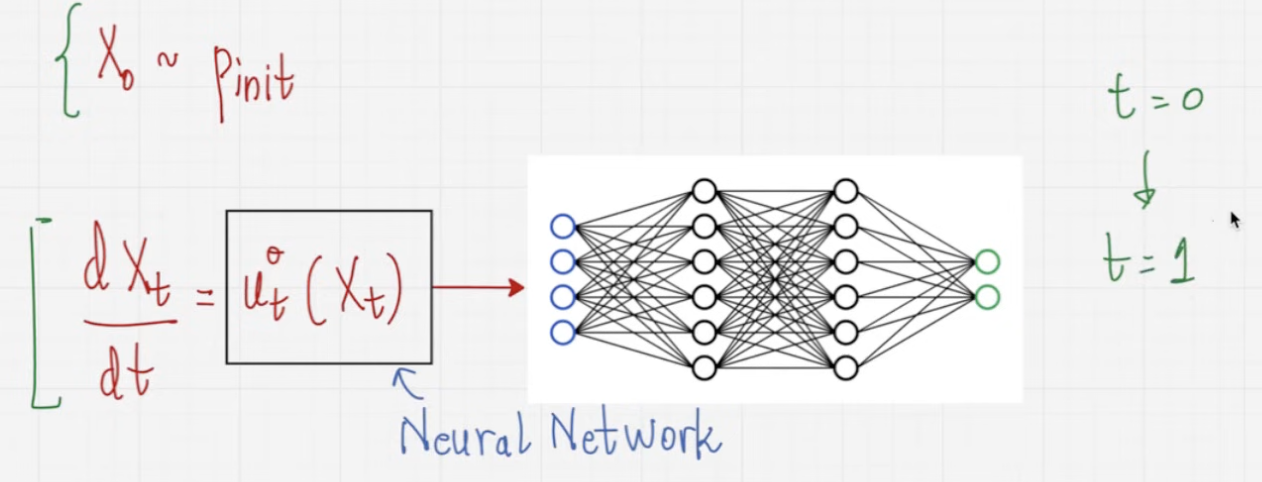
- our goal is to make the endpoint x1 of the trajectory have dist pdata
- the neural network that predicts this ODE is aka neural ode
Links:
202609251146