Transformers
neural networks for object detection
-
object detection is the most fundamental and extensively researched topics in machine vision
-
it requires both identification and localization of objects:
- identification - classification eg - laptop, table, person etc
- localization - position and size or bounding boxes
- other properties - velocity, visibility are also possible
-
2 stage detectors:
-
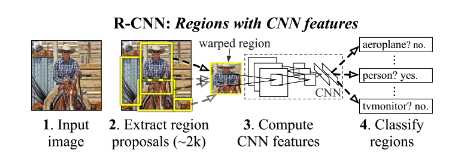
RCNN
- extracts region proposal from input image using classical computer vision techniques (no learning or nn)
- computes features for individual boxes via CNN (only take region of box as input)
- use linear regressor for box refinement (cropping and resizing) and SVM for classification or object presence
- slow as the network runs fwd pass for all bounding boxes
-
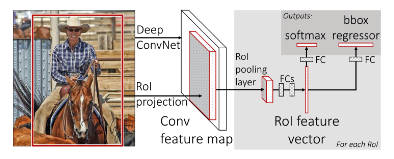
Fast R-CNN
- input image is fed into a CNN to generate a convolutional feature map
- RoI (region of interest) pooling layer aggregates region proposal to a fixed size
- unified FCN for regression and classification
- Fast R-CNN is roughly 9x faster in training and over 200x faster during test
-
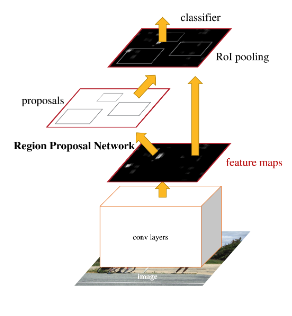
Faster R-CNN
- learn region proposal with a separate network
- use anchor boxes of multiple scales and aspect ratios to better handle objects of various sizes
- reduces detection time to around 0.2 seconds per image, enabling real-time object detection applications
-
-
1 stage detector
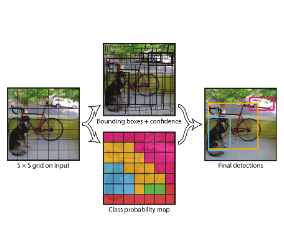
- YOLO - you only look once
- one CNN for both regression and classification
- uses a SXS grid, with each cell containing k anchor boxes
- for each anchor box in each cell:
- predict final box attributes and confidence score (x, y, h, w, confidence)
- predict scores for each class (including background)
- similar to region proposal network but specific for each class
- YOLO - you only look once
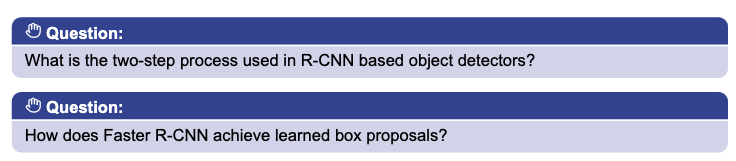
- extracting region proposals → computing cnn features
- using a region proposal network
why transformers?
- sequence modelling
- sequences are natural representations for text data
- RNN based models - Seq2Seq, LSTMs, GRUs have traditionally been used to model sequences by capturing contextual relationships
- limitations of RNNs:
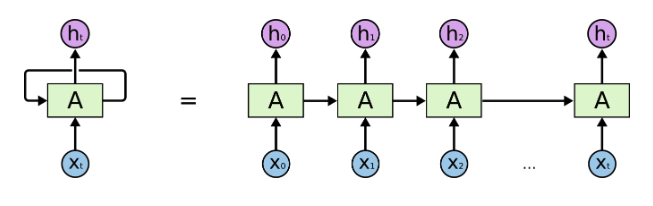
- limited contextual understanding due to long-term dependency challenges from vanishing gradient problem
- both vanishing gradient and exploding gradient problem
- inherent sequential nature leads to slower training
- high computational load and memory constraints
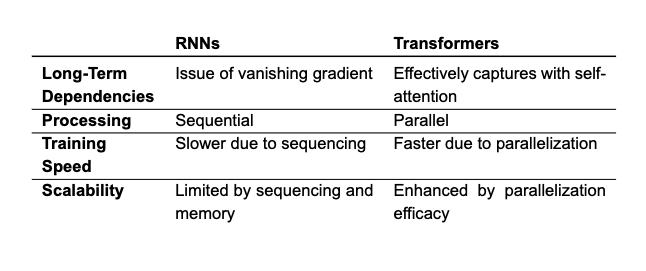
- parallelization, efficiency, can capture long term dependencies, no vanishing and exploding gradient problems
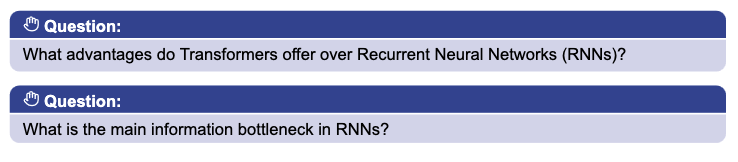
- the fixed-length context vector that forces the encoder to compress an entire input sequence of arbitrary length into a single vector representation
the attention mechanism
-
The 2 types of attention:
- self-attention - when the input and the target are the same ex- attention between the words in a sentence
- cross-attention - focuses on an additional input signal as supplementary info (input and target are different) ex- a text and an image!
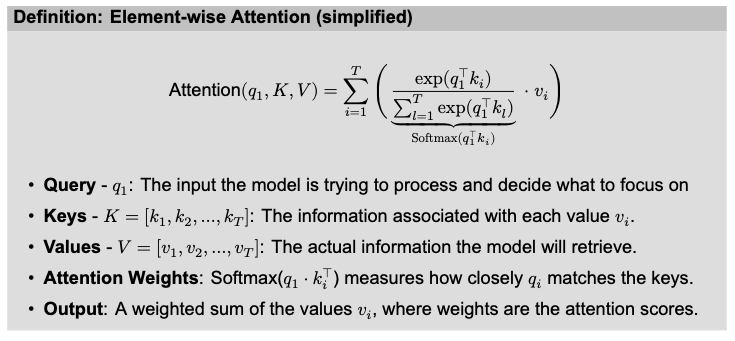
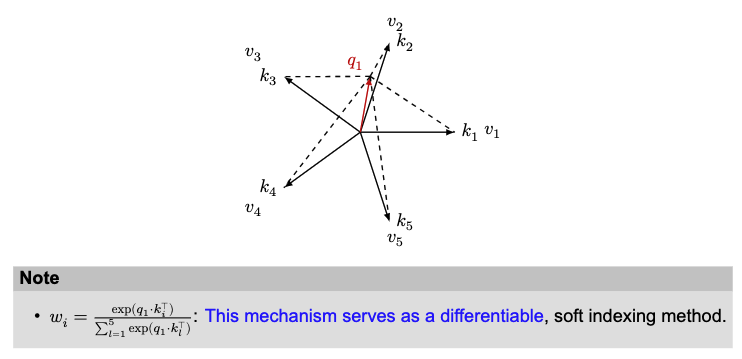
- we convert the similarity scores into probabilities and multiply weights w_i x v_i to compute the output as weighted sum of the values
-
Scaled Dot Product attention
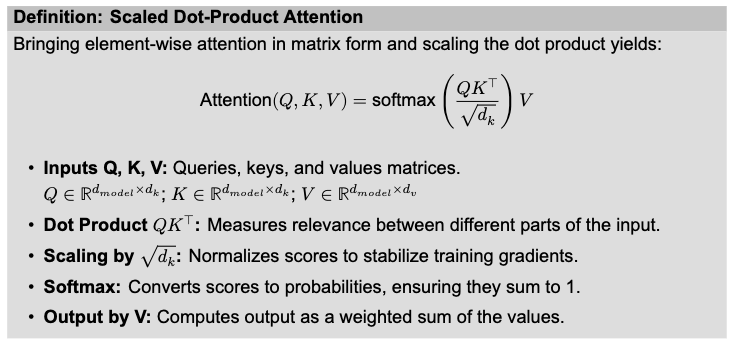
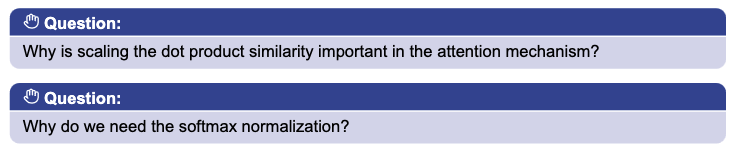
- normalizes scores to stabilize training gradients
- converts scores to probabilities ensuring they sum to 1
Links:
202609181658