transformer for text
Transformer Architecture
-
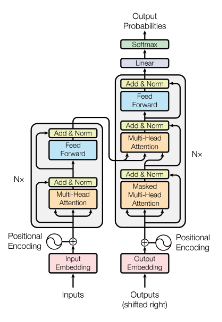
blocks of transformers:
- encoder
- decoder
- attention
- feed-fwd networks (FFN)
- layer normalization
- positional encoding
-
input word → vectors (input embeddings) which contain semantic/linguistic meanings → fed to the encoder block
-
decoder works auto-regressively meaning any prev generated output is fed back into the decoder again!
-
Encoder:
- 6 identical layers (6 encoder blocks as per the original paper)
- sub layers:
- a multi-head self-attention layer
- a token-wise feed forward network
- integration of residual connections and layer norm in each sub-layer
-
Decoder:
- 6 identical layers
- adds a third sub-layer for multi-head attention over encoder outputs:
- incorporates masking to ensure auto-regressiveness, allowing predictions for position i depends solely on prior outputs
- utilizes a triangular masking matrix to prevent future information from affecting current predictions
-
Attention mechanism
-
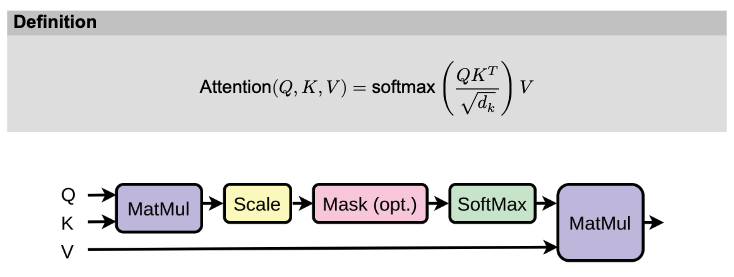
Full masking for bidirectional modelling - attends to the words before, after and itself (used in the encoder)
-
Triangular masking for unidirectional modelling - only attends to preceding words and itself (used for generating text in the decoder) by masking with large -ve numbers whose softmax is 0
-
Multi-head Attention Mechanism
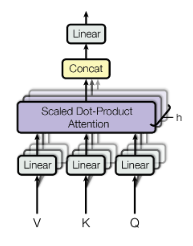
- enhances the ability to capture more complex relationships by focusing on multiple aspects of the input
- combines multiple scaled dot product attention modules as attention heads
- each head independently focuses on different parts of the input - semantic, linguistic, etc
- finally we concatenate the output of all the heads and pass the output through the linear layer
one limitation of attention is that it is permutation invariant
-
positional encoding
- to overcome this limitation of attention we use positional encoding which helps the model understand the sequence of the tokens
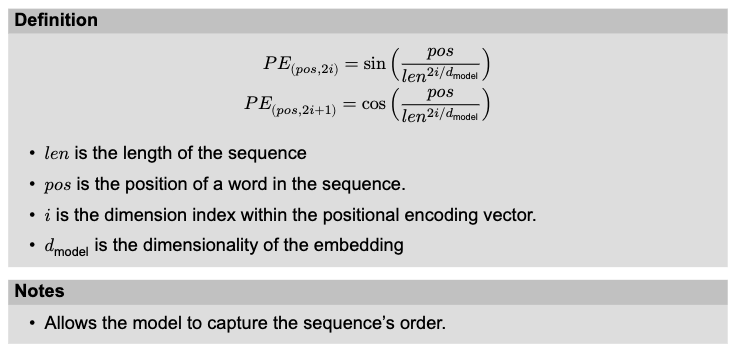
- to overcome this limitation of attention we use positional encoding which helps the model understand the sequence of the tokens
-
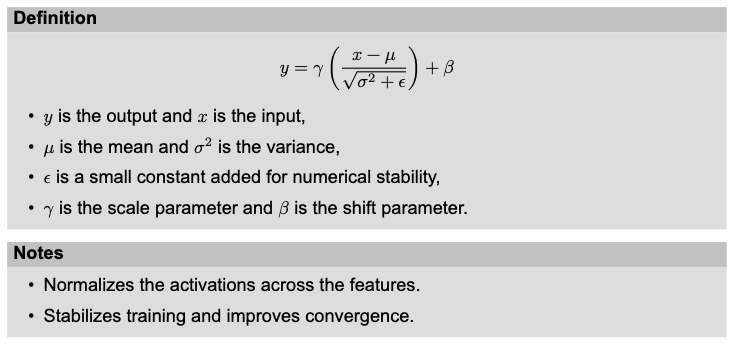
Layer Normalization
Note: we do not use batch norm because our sequences can be of varying length and that might make it unstable or inaccurate instead layer norm works for each token independently
-
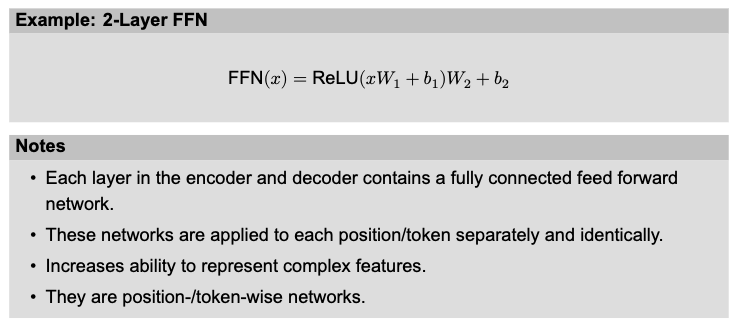
Feed Forward Networks
-
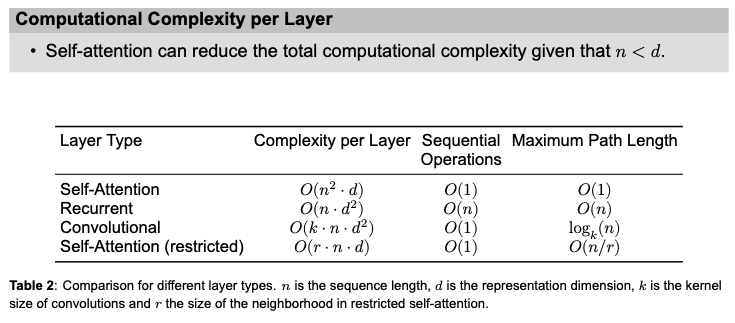
Why self-attention in transformers?
-
Parallelization - self-attention enables greater parallelization by involving a constant number of sequentially executed operations
-
Path-length for long-range dependencies - minimizes the path length that signals need to traverse in the network
-
Illustrative example of transformers:
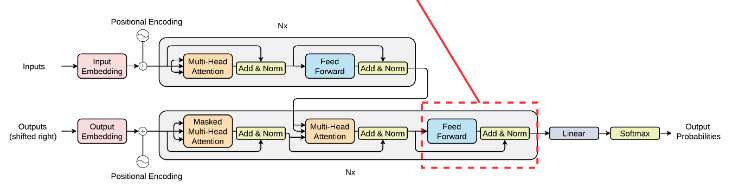
- first the inputs are converted into embeddings and positional encoding is added
- each word is a token with a specific learn representation or embedding
- multi-head attention captures the attention between different tokens in the sequence
- add+norm + feed fwd - full understanding of the sentence identifying imp words and relationships
- decoder output embeddings - begin constructing while looking at previous translations
- decoder masked-multi-head attention - determine the best words for translation on what has been translated so, without looking ahead(masked)
- decoder MHA - utilize the prev translation and the newly input text to identify the most likely words
- feed-fwd + add norm - normalize the data and transform it
- linear + softmax - generate output words
- transformers inherently do not account for the order of tokens, as the attention mechanism is permutation-invariant. To encode word order, positional encodings is required.
- To make sure word only attends to preceding words and itself Triangular masking is used aka Causal masking
Classifications of Transformers
- classification by architecture:
- Encoder only transformer - specializes in processing input data eg. BERT
- Decoder only transformer - focused on generating outputs from learned representations eg. GPT
- Encoder-Decoder transformer - combines both functionalities, ideal for tasks like translation (eg. the original transformer model, T5)
- BERT (Bidirectional Encoder Representations from Transformers)
- BERT is designed primarily for transfer learning
- Pre-trained with 2 self-supervised objectives, then fine-tuned on downstream tasks
- No human-annotated data needed, allows for training on vast, unlabelled datasets
- embeddings
- token embeddings - represent individual words or subwords in the seq
- segment embeddings - to indicate the sentence A or B
- position embeddings - to indicate the pos in the seq
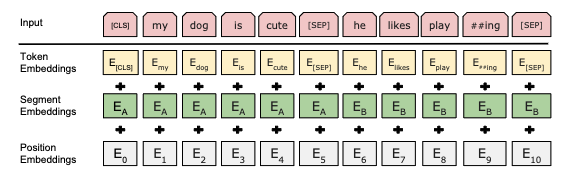
- special tokens:
- CLS - learnable token (CLS stands for classification and is used to represent sentence-level classification)
- SEP - indicate the end of the sentence
- pre-training
- benefits:
- contextual understanding - enables BERT to grasp language context, crucial for downstream tasks
- transfer learning - pre-training on large datasets allows BERT to learn generalized representations, which can be fine-tuned with smaller datasets for specific tasks
- efficiency and accuracy - pre-trained models boost performance and speed for NLP tasks compared to training from scratch
- objectives
- masked language modelling (MLM)
- next sentence prediction (NSP)
- benefits:
- Mask Language Modeling - MLM
- randomly mask out words in the input sequence
- predict the masked words with the context from the input itself
- encourages the network to understand contextual relationship at the word level
- Next Sentence Prediction - NSP
- takes 2 sentences A and B from the dataset
- B is the next sentence of A 50% of the time, the other 50%, B is randomly chosen
- the task is to predict if B truly follows A
- encourages the network to understand contextual relationships at the sentence level
- Encoder Only transformer
- efficiency and size reduction
- DistilBERT - Knowledge distillation to reduce size
- ALBERT - Lowers memory use by optimizing embedding layers and sharing parameters across layers
- Improvements in Attention Mechanism:
- DeBERTa - Utilizes a disentangled attention mechanism encoding the content of words and their positions separately
- Longformer - Introduces a blend of local windowed and global attention to efficiently manage longer texts.
- efficiency and size reduction
Advanced Transformer Variants
Links:
202609182212