multimodal deep learning
what is multi-modality and why is it needed?
- deep learning models may leverage 2 or more modalities - image, text, audio, 3d, video etc
- human perception is multimodal
- applications - VQA, visual and video grounding, autonomous driving etc
- DL models especially transformer based are data hungry so “more modalities = more data”
- healthcare, medical imaging, robotics, virtual assistance, gen AI
- transformers are:
- model agnostic architectures - everything can be tokenized
- attention enables cross-modal interactions
- transformers scale well with data, and can be pre-trained
multimodal interaction paradigms and effects
-
fusion - combines multiple modalities to jointly produce a single, shared output
-
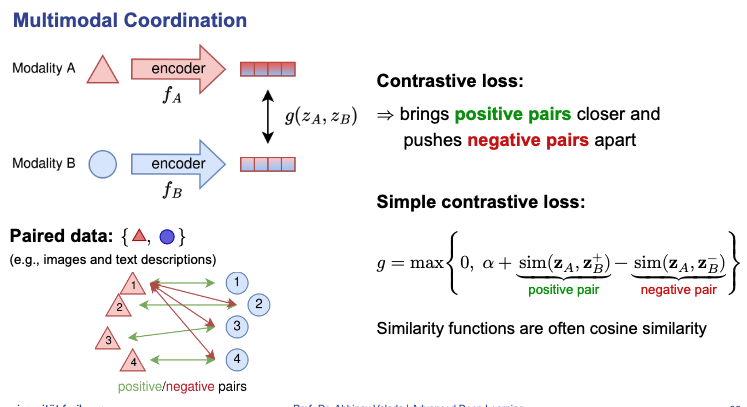
coordination - keep per-modality representations separate, but align them with each other
-
fission - decomposes a shared representation back into modality-specific outputs
-
Multimodal fusion:
-
Fusion combines modalities providing a joint output.
-
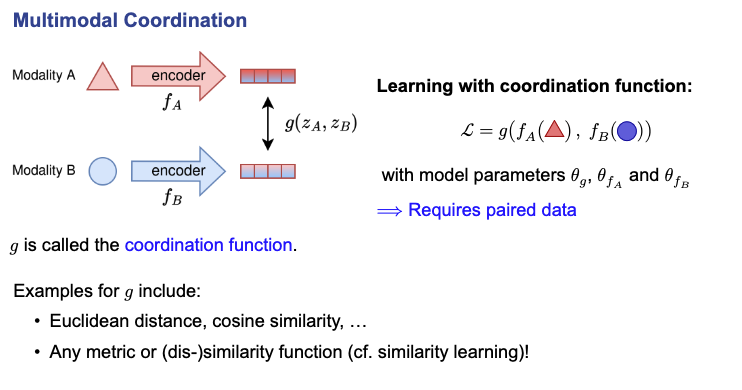
Coordination aligns outputs, but each modality still has an individual output, and processing itself may not happen jointly.
-
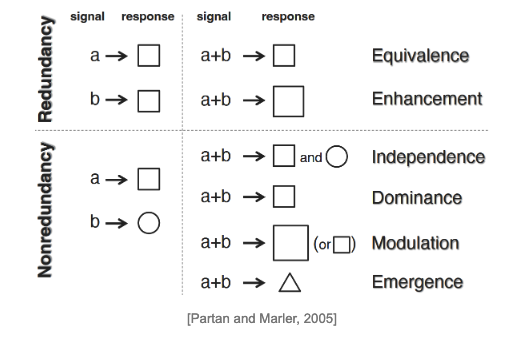
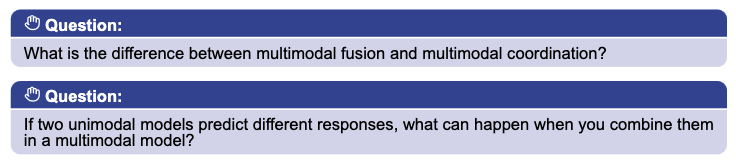
the joint output can be inconclusive, can be dominated by one modality, can be modulate, or we can get emergent info that cannot be derived from either modality independently!
interaction strategies
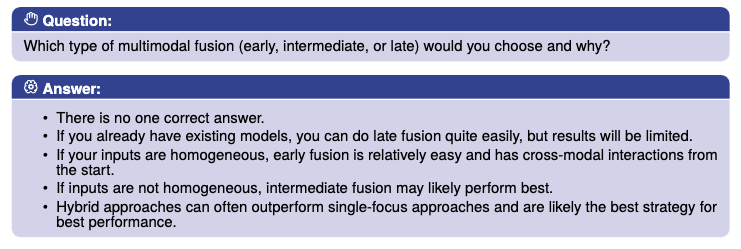
- raw or early fusion
- fusion at raw level or at data level
- requires the modalities to be homogeneous (otherwise cannot be fused!)
- ex- fusion of rgb, depth and skeletal data
- output or late fusion
- make pred for each modality separately and then fuse the pred
- supports heterogeneous modalities (because each modality is processed separately)
- ex- avg, voting, highest prob, learning-based etc
- intermediate fusion
- extract feat for each modality, fuse feat and pred jointly
- supports heterogeneous modalities
- early fusion - common in transformer based arch where one modality is transformed to match another modality
- hybrid fusion - at diff stages
imp to understand the diff
-
multimodal fusion - learn a shared representation capturing interactions across modalities, producing a unified output
-
multimodal coordination - learn a separate per-modality representation that are aligned with each other ex- used for cross modal retrieval
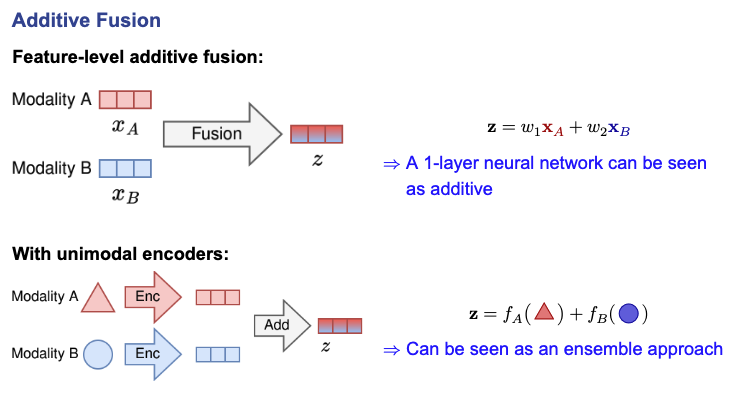
feature fusion
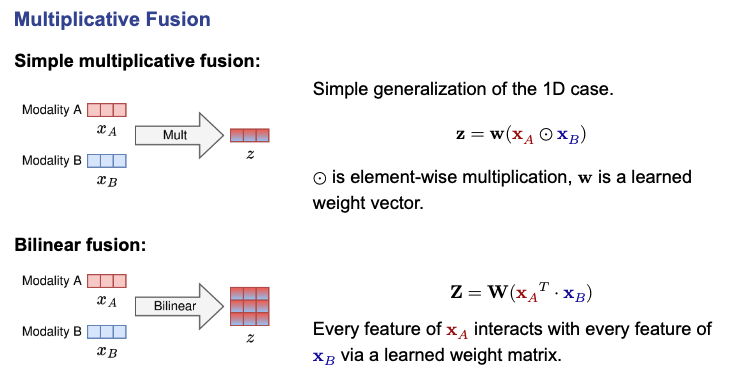
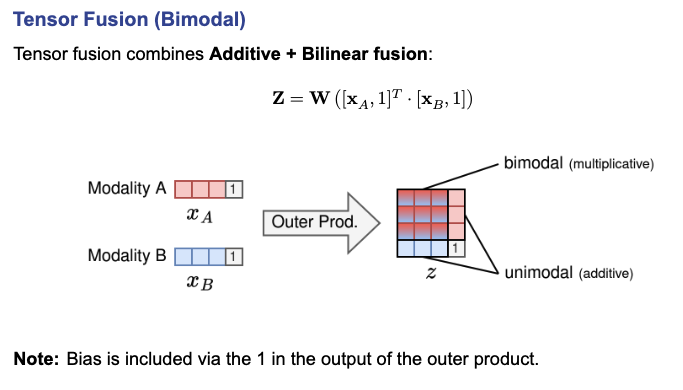
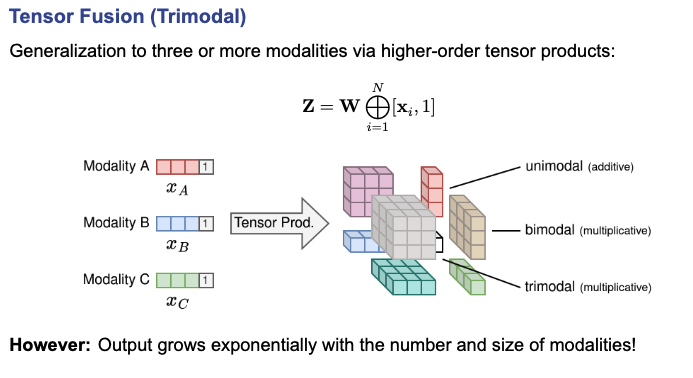
- higher order fusion
- we can already make unimodal + bimodal + trimodal terms using fusion but can we add higher-order interaction terms like - xa^2 + xb^2 etc
- we could but it would be computationally expensive
- better way - fuse all features into a single feature vector → f = (1, z1, z2, z3…) and multiply it P times to get P-modal terms → F = f.f.f.f.f… P times
- ex - if we have a feat vector of 100 feat and we want P=5 we would have 100^5 elements in the matrix which is un-computable hence we never compute it but use a low rank tensor network W to contract it into a smaller more useful matrix Z
- how can we model highly non-linear interactions?
- using neural networks by concatenating feat and letting the n/w learn how to fuse them! y’ = f((Xa, Xb,…))
- tensor fusion is a combination of unimodal and bimodal parts, hence combines additive and bilinear fusion
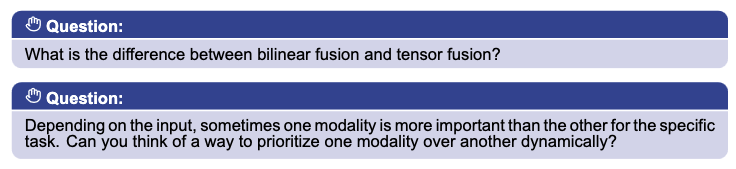
- we can compute an attention weight maybe based on a neural network
Vision and Language - Early and BERT like models
- early models for vqa used an LSTM to process the text and a CNN to process the image finally having 1024 FC feature representation which was then element wise multiplied (fusion) to predict the final softmax prob!
- FiLM - Feature wise Linear Modulation modulated the output of each layer of one modality conditioned on the other modality ex- the text is processed by a GRU type RNN which helps train a gamma and a beta params that are used by the CNN layers
- BERT - Bidirectional Encoder Representations from Transformers is used primarily as a text encoder in various NLP tasks and is pre-trained with 2 self-supervised objectives, and fine-tuned on downstream tasks. No human annotated data is needed and it allows for training on vast unlabelled datasets
- extending BERT to vision and language?
- how to encode images? (Region features, CNN features, linear projection)
- how to model interactions? (single or dual stream)
- BERT + Vision - VilBERT
- ViLBERT (Vision and Language BERT) - Region features (Faster RCNN) + Dual stream
- uses self-attention for unimodal refinement
- uses cross-modal attention for multimodal interactions - use Q from one modality and V, K from other modality
- BERT + Vision - UNITER
- UNITER - Universal Image-Text Representation - Region features (Faster R-CNN) + Single stream
- self attention on concatenated visual and language tokens allows for multi-modal interactions
- CONS- region feat extractors are slow takes around 900ms, trained on a fixed set of classes and lose all context information
- BERT + Vision - Pixel-BERT
- replaces region features with CNN features (ResNet or ResNeXt) + Single stream.
- random sampling of pixels for computation reduction and semantic reasoning.
- BERT + Vision - ViLT
- ViLT (Vision and Language Transformer) - Linear projection of patches (ViT) + Single stream. Linear projection drastically decreases runtime with similar performance
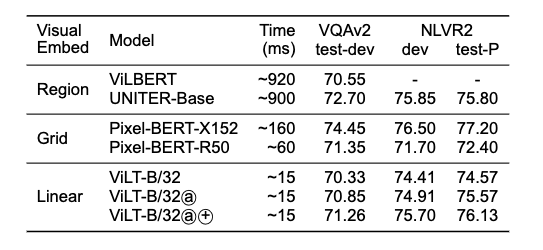
- ViLT (Vision and Language Transformer) - Linear projection of patches (ViT) + Single stream. Linear projection drastically decreases runtime with similar performance
- The main difference lies in the way the images are encoded and tokenized (region based, CNN, linear proj) and the way multimodal interactions are performed (single vs dual stream)
- we take queries from one modality, keys and values from other modality
- Multimodal masked language modeling, image-text matching
Links:
202609121311