small language model
read - https://www.ibm.com/think/topics/small-language-models
- the rise of LLM models
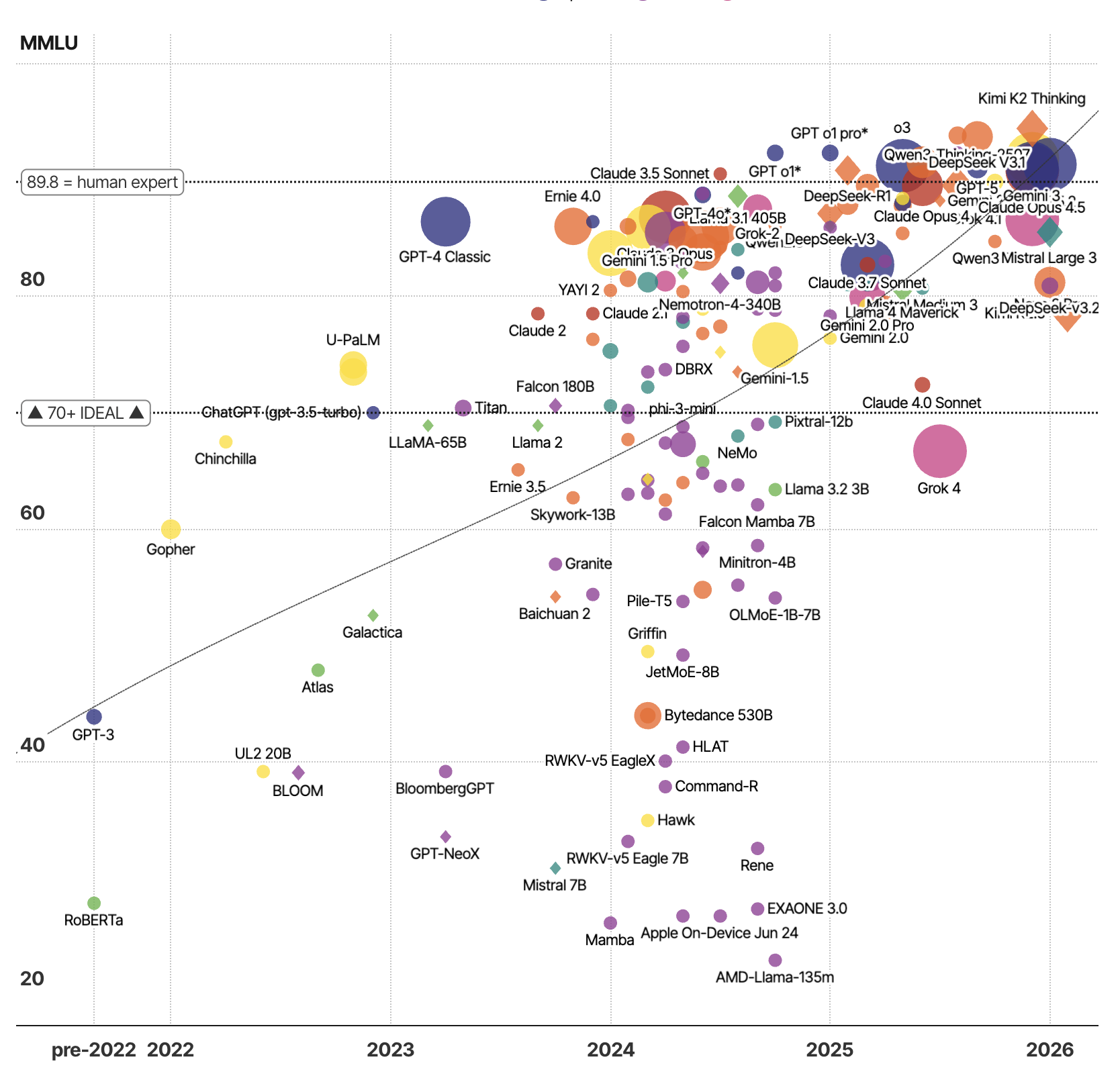
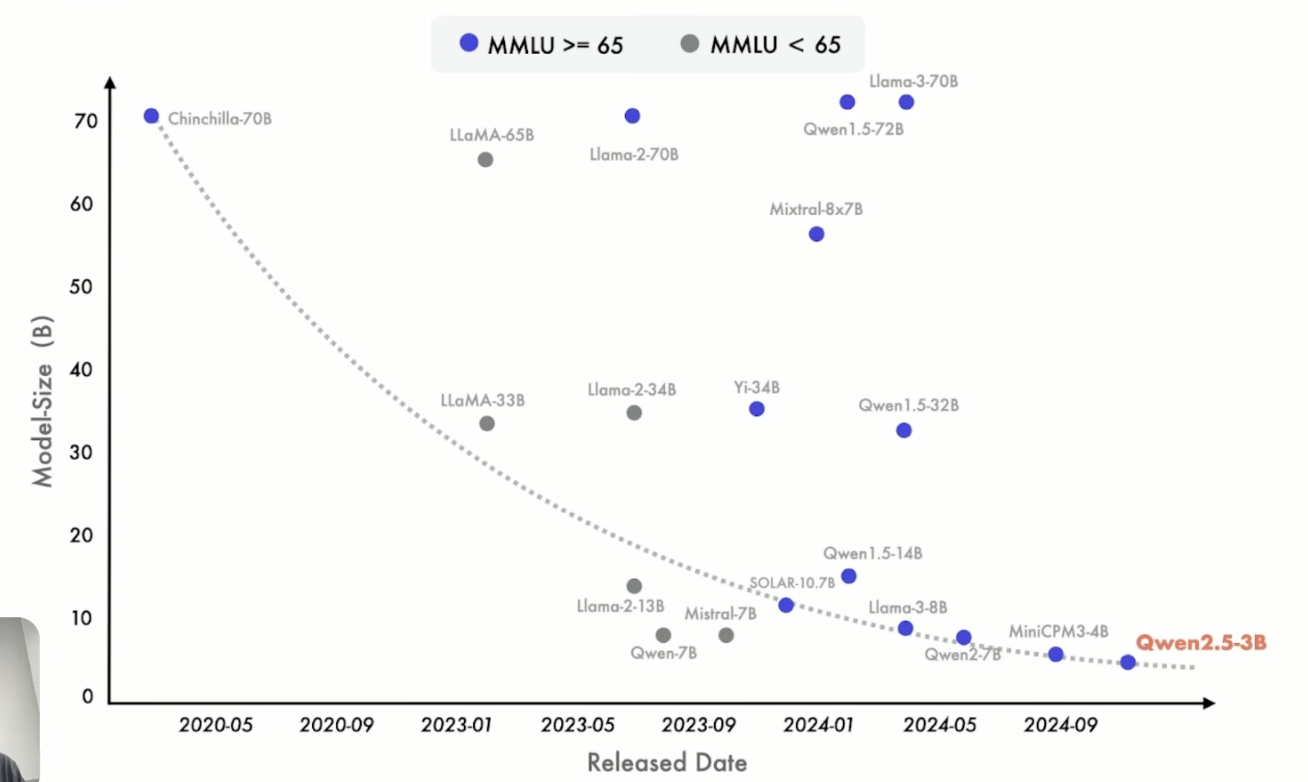
- why we need SLMs?
- LLMs are large and need more computational power to run and train
- SLMs contain less than 10B⇐ params whereas LLMs have 100B+
- SLMs are fast and efficient and can be deployed on small devices like phones, laptops, IoTs and can be fine tuned for specific tasks like healthcare, legal, customer support etc
- On device privacy
- ex - Microsoft Phi-3 Mini (3.8B), Google’s Gemma 2 (2B-9B) and Meta’s Llama 3.2 (1B-3B), DistilBERT, Mistral Ministral, Qwen2.5, SmolLM2
- Dataset
-
tiny stories dataset - https://huggingface.co/datasets/roneneldan/TinyStories generated by GPT-3.5 and 4 - https://arxiv.org/pdf/2305.07759
-
the goal of this dataset is to have as small dataset as possible while having all the concise information to teach something to the model
-
so our task is to use this dataset which contains many tiny stories in english for 3-5 year old children, can we successfully teach english to our SLM which is going to be only 15M params - if yes, then our goal is achieved!
Goal: can we construct a language model with just 10-15M params and which produces coherent text?
-
the dataset contains 2.2M rows - every row is a story!
- training - 2.1M
- validation - 20k
- Data pre-processing
-
since LLMs cannot understand words like humans, we need to tokenize the stories in some way to convert them into numbers using tokenization:
- types of tokenization:
- character level tokenization - each character is a token
- word level tokenization - each word is a token (english language has a big vocabulary so too many number of tokens, also spelling mistakes would not be a token!)
- subword tokenization or byte pair encoding - characters and some basic words are tokens but some subwords are also tokens which can form new words like “tokenization” = “token” + “ization” ex- Byte Pair Encoding
- types of tokenization:
-
so we follow a roadmap something like:
- dataset → tokenizer → tokens → token id
-
the dataset contains rows of stories where each story is a row or a data sample and there are 2 million such rows for training and nearly 20000 such rows for validation!
-
iterating through the setup with a small example, we have to do 2 things:
-
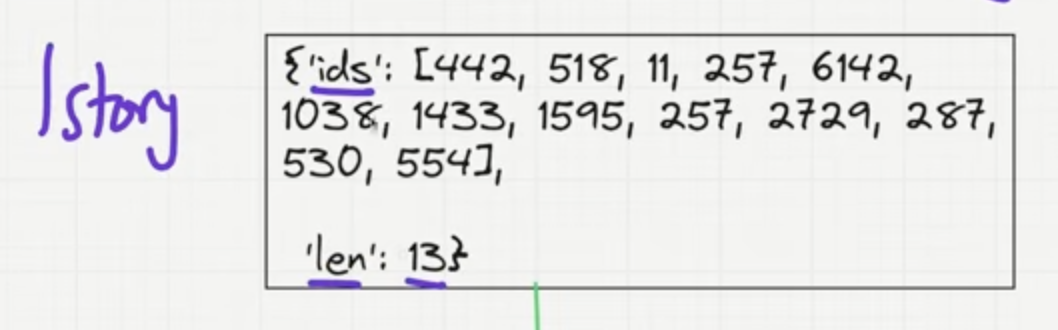
tokenize the dataset → use gpt 2 subword tokenizer (BPE) for example 1 story is a collection of token ids with its length.
-
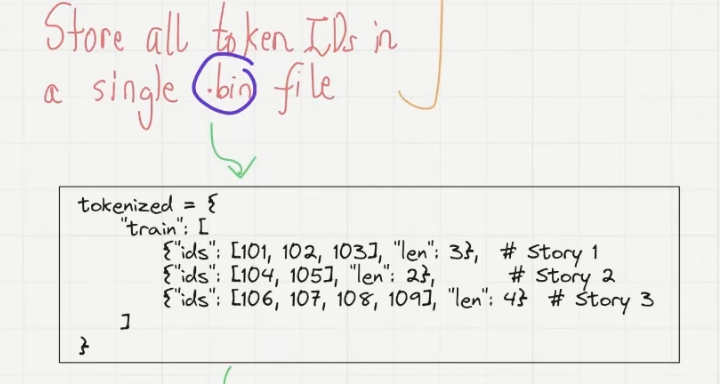
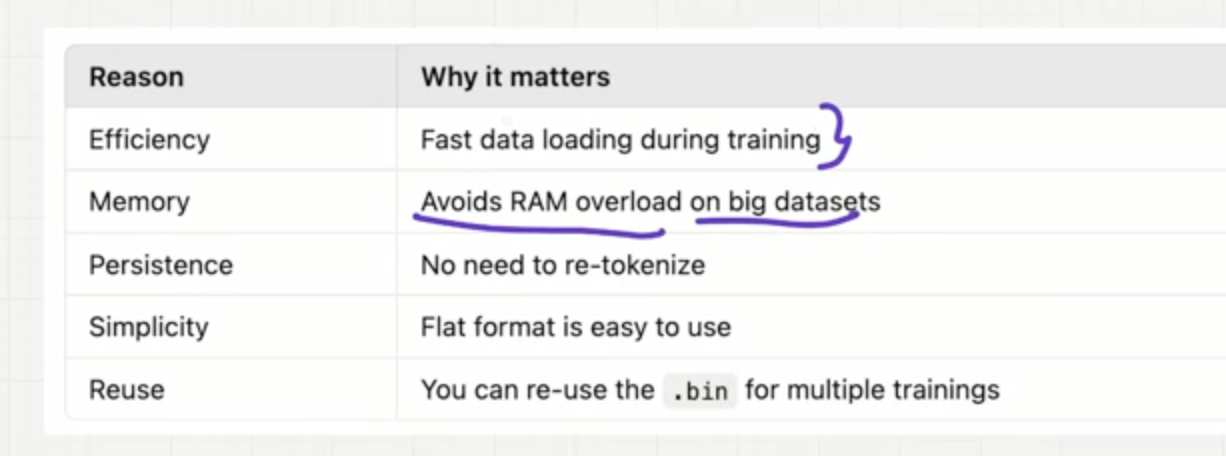
store all the IDs in a single .bin file! why?
-
-
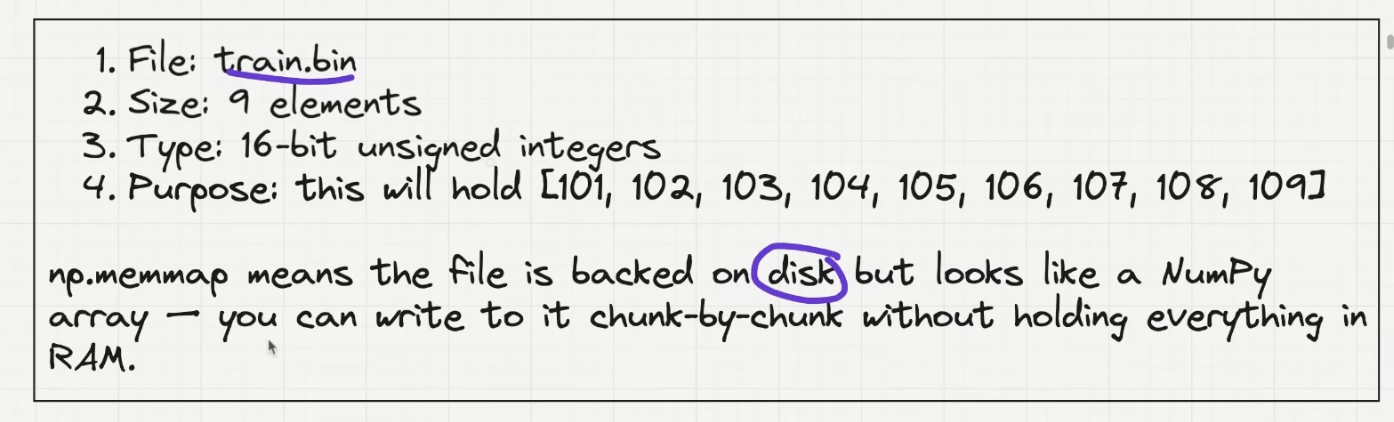
we are storing the bin file as a memmap
-
split into batches (for faster loading in RAM) and add everything as a whole into train.bin and validation.bin for validation and test datasets!
-
creating input and output pairs from Dataset! why?
- because LLM is a a next token prediction task and we want to take a sequence of tokens and predict the next token so we need ip and output pairs to calculate our loss!
- context size - max len of words of tokens that the LLM needs to see to predict the next token ex- 4
- batch size - the number of samples that the network processes to update the weights once!
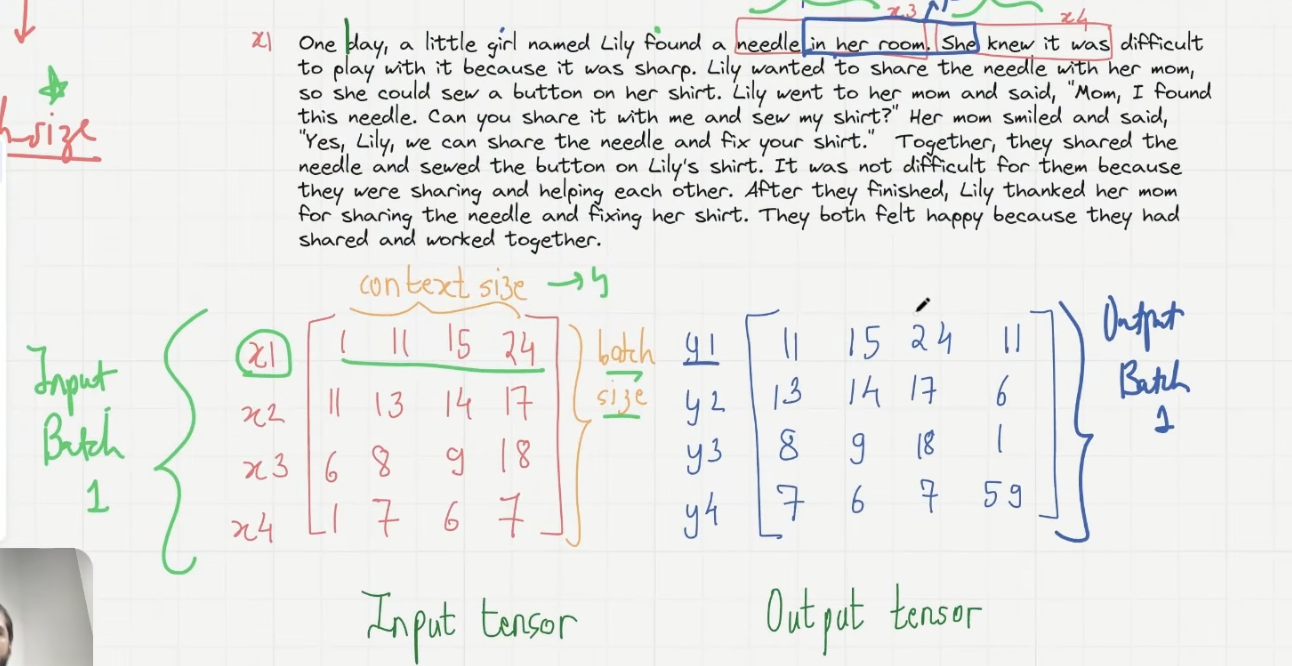
- when creating the input output pairs, we always stack the input tensor in batch_size x context_size matrix and output tensor in batch_size x context_size matrix but one token shifted meaning for each row, we have context_size number of tasks!
- Assembling the model architecture
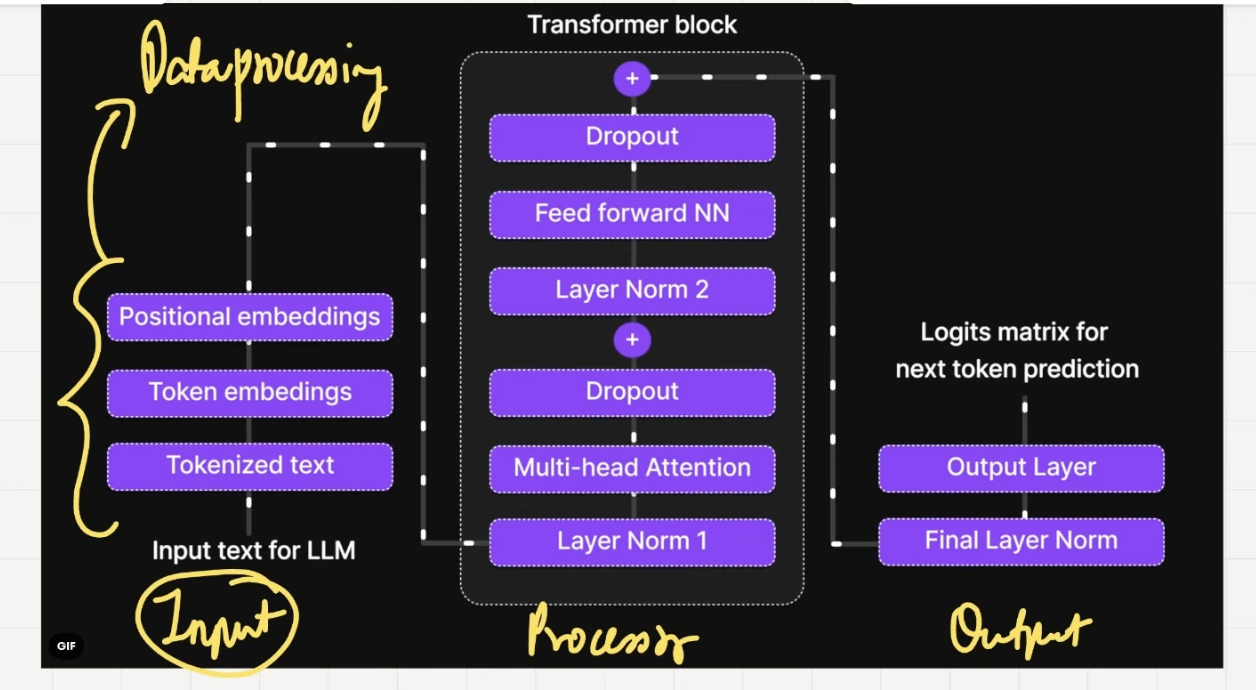
- first we get the tokenized text which is our input dataset but tokenized
- each token is then transformed into a 768 dim vector using a dictionary which stores 768 dim vector for each token in the vocabulary of the LLM called as token embedding
- finally we want to add positional embedding which gives the neural network the order of the tokens ex- “the dog eats the cat” and “the cat eats the dog” would have the same meaning in the n/w if there was no pos embedding!
- the pos embedding is the same for all sample, as the number of pos would be at max → context size ex - 1024
- the token embeddings and pos embeddings are intially randomized matrix
- If your input has shape
(B, T)=(8, 1024):tok_embbecomes(8, 1024, 768)pos_embbecomes(1024, 768)(broadcasted across the batch)x = tok_emb + pos_embproduces the final tensor of shape(8, 1024, 768), ready to enter the Transformer Blocks.
- coming to the transformer block:
-
pre-layer norm - we normalize the tokens across the embedding dim of 768 so that the mean=0 and var=1
-
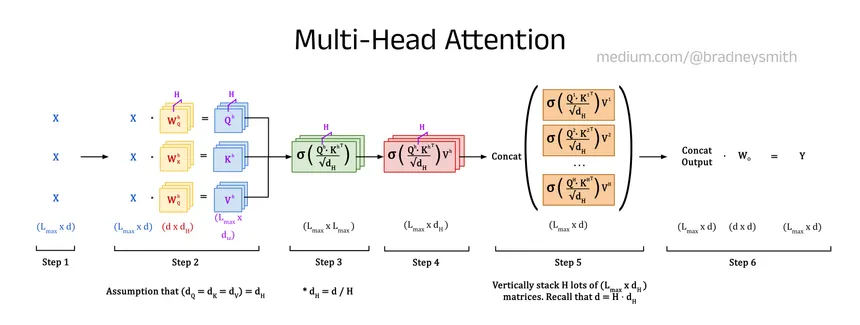
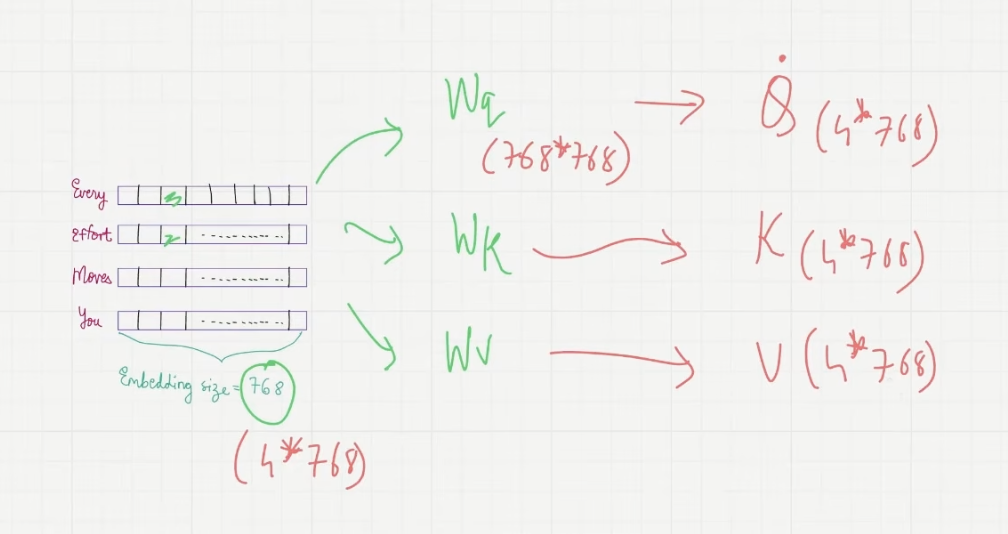
MultiHeadAttention
- takes the embedding vectors and converts them into context vectors which contains the context of how a token relates to others!
- so masked multihead attention takes the embedding vector of size 768 and converts it to context vector of the same size!
- causality - a token should not attend to future tokens
-
-
Setting up the SLM training pipeline
-
Pre-training the SLM
-
Running inference
Links:
202608280808